Transitioning from military to civilian life is a comprehensive journey that demands a thoughtful approach to personal well-being. This issue, we’ll discuss an element of holistic health that is familiar to all Veterans – physical activity.
With that said, we have as much to unlearn as we have to learn about physical activity. The military’s goals and outcomes for physical activity differ from our personal civilian journey. Our military is and should be creating a lethal fighting force in the present, we are creating routines that enable us both in the present and are sustainable into the future.
For example, 10 side straddle hops in preparation for a five-mile run with minimal stretching after is recipe for injury. When we are 20 this isn’t as big of a risk, but as we age the margin for error diminishes. Taking a holistic approach to our physical activity isn’t a recommendation, it’s a requirement if we want to continue an active lifestyle.
In the military, physical activity can often be treated as a stand-alone activity, but that only works for 20 and 30 somethings, not 40 somethings. With thoughtful planning we can work to reduce risk and continue performance at the highest level.
When we embrace physical activity after leaving the military, we have to understand not every workout needs to reach muscle failure if our goal is long term health. Recovery, nutrition, rest, and planning all play crucial roles.
Here’s some things to think about as we get started:
- Get a full check up with your doctor before you start – together you can identify areas for improvement and focus
- Identify and set physical baselines
- Set realistic and achievable goals
- Make the timeframe to reach those goals shorter in duration – this will allow you to reassess and adjust
Rules of Thumb:
- Check your ego – Not every workout needs to reach muscle failure.
- Train for your life now, not what it was.
- Injuries should be respected and taken seriously.
- Recovery and Nutrition will amplify efforts.
MilitaryConnected.org is a nonprofit organization improving the military-connected community’s transition experience through employer education, data driven research, and access to a network of job opportunities with military-ready employers.
The Vegetus Foundation is dedicated to helping Americans improve their quality of life through education on healthy living and has published the Nutrition Health Review since 1979. Learn more at nutritionhealthreview.com



Any disruption to our routine, particularly something as significant as transitioning from the military, can lead to us putting our own health or fitness a lot further down the priority scale than it should sit. It’s important to remind ourselves that taking care of family members or fellow Veterans requires a little selfishness in taking care of ourselves.
When we leave the military, everything is going to feel new. With moving, ETS-ing, getting your gear turned in, finding new schools for our kids, we are going to fall of the horse.
Getting started again is the hardest part. While we recognize part of the Veteran transition means evolving from “Can you just tell me what you want me to do and I’ll execute?” to creating your own path, sometimes a little guidance can help. Below is a sample workout schedule that can help you get re-started.
WEEKLY WORKOUT STRUCTURE
(BEGINNER)
Monday: Foundational Strength
- 30-minute bodyweight exercises
- Exercises: Modified push-ups, air squats, walking lunges
- 15-minute light stretching
- Focus on proper form and technique
Tuesday: Low-Impact Cardio
- 20-30 minute walking or light jogging
- Optional: Stationary bike or elliptical
- 15-minute gentle yoga stretches
- Listen to your body, no intense pushing
Wednesday: Recovery and Mobility
- 30-minute walking
- Foam rolling
- Gentle stretching
- Focus on reducing muscle soreness
Thursday: Beginner Strength Training
- Light dumbbell or resistance band exercises
- 20-30 minutes total body work
- Emphasis on learning correct movements
- 15-minute cool-down stretching
Friday: Cardio and Core
- 20-minute brisk walking or light cycling
- 15-minute core stability work
- Gentle stretching
Saturday: Active Recovery
- Light walking
- Yoga or stretching
- Optional: Light swimming or recreational activity
Sunday: Complete Rest
- Mental and physical recovery
- Focus on sleep and relaxation
WEEKLY WORKOUT STRUCTURE
(ADVANCED)
Monday: Intense Strength Training
- 75-minute compound lifts with controlled movements
- Focus on functional strength with
reduced injury risk - Advanced mobility work
Tuesday: High-Intensity Interval Training (HIIT)
- 45-minute metabolic conditioning
- Low-impact cardio intervals, resistance band circuits, swimming
Wednesday: Active Recovery with Performance Focus
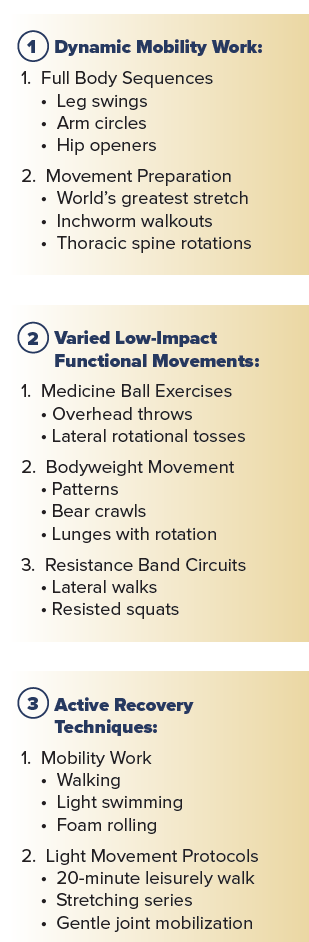
- 60-minute dynamic mobility work (box 1)
- Vinyasa yoga, pilates
- Targeted mobility for specific muscle groups
Thursday: Strength and Stability Training
- Resistance training with focus on stabilization
- TRX and bodyweight strength work, kettlebell exercises with strict form
Friday: Endurance and Speed
- 60-minute high-intensity cardiovascular training
- Cycling or swimming intervals, hill walking or stair climbing
Saturday: Functional Fitness Challenge
- Low-impact functional movements (box 2)
- Try to work with a partner or find some small group training
- Performance-based challenges
- Go for a hike or try a workout class
Sunday: Strategic Recovery
- Active recovery techniques (box 3)
- Mental reset and goal setting
- Sleep optimization protocols